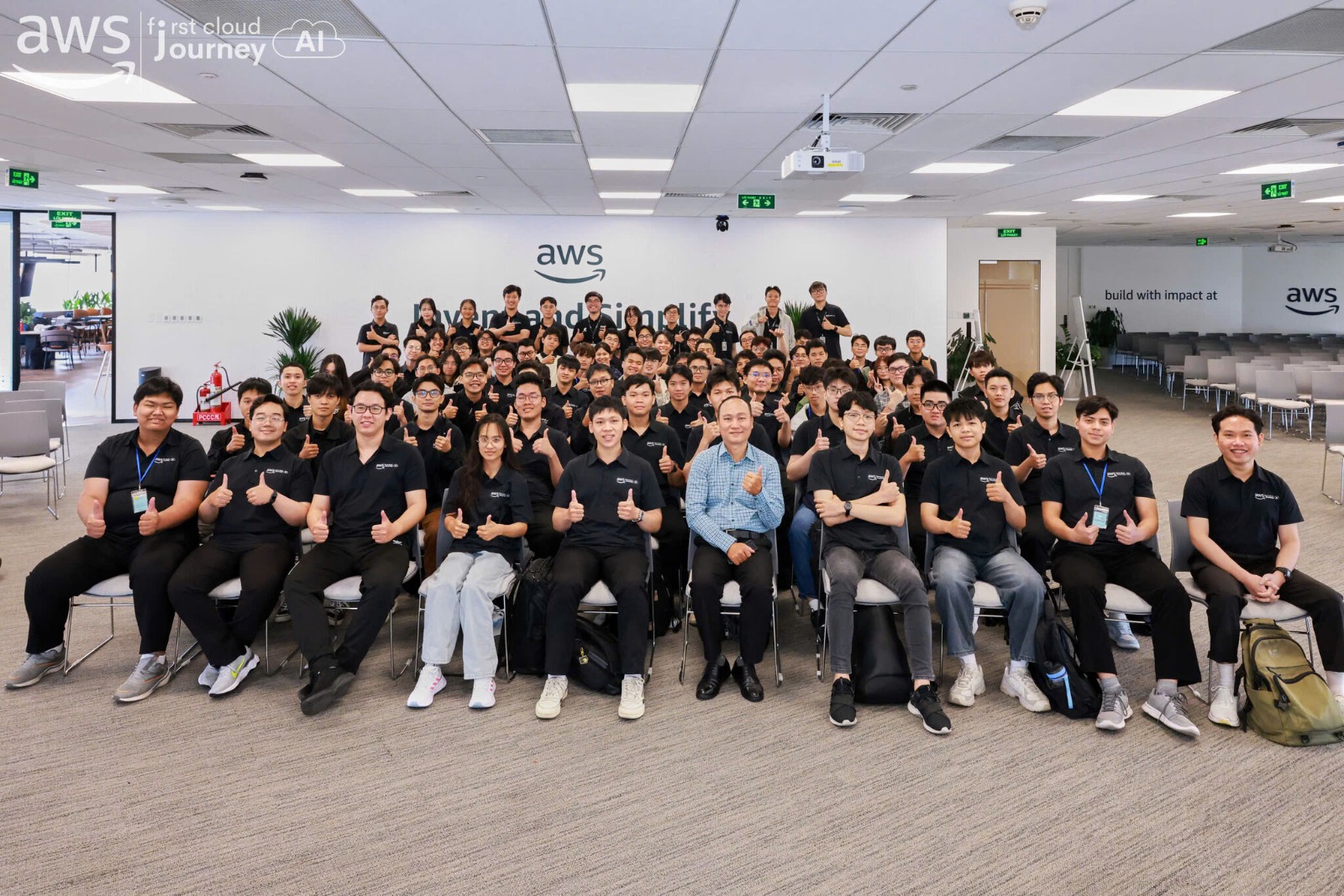
Event 2
Summary Report: “Cloud Mastery”
Event Overview
- Event Name: Cloud Mastery
- Date: March 14, 2026
- Role: Attendee
- Format: Technical talk and knowledge sharing
- Topic: Automated Prompt Engineering: Enhancing LLM Output Quality
At the Cloud Mastery event, I attended a session titled “Automated Prompt Engineering: Enhancing LLM Output Quality”, which explored why well-crafted prompts are critical for getting reliable, high-quality outputs from Large Language Models (LLMs), and how systematic prompt engineering techniques can be applied to consistently improve results while optimizing costs.
Session Content
Why Good Prompts Matter
The session opened with an exploration of why prompt quality is the single most impactful factor in determining LLM output quality:
- Poorly structured prompts lead to vague, inconsistent, or irrelevant responses
- Well-engineered prompts dramatically reduce the need for manual post-processing and corrections
- Systematic prompt design enables reproducible, high-quality results across different use cases
- Good prompts contribute to cost efficiency by reducing the number of API calls and token usage needed to achieve desired outputs
Prompt Structure Framework
A core part of the session was a structured framework for building effective prompts, consisting of five key components:
- Role: Defining who the LLM should act as (e.g., “You are an experienced Python developer” or “You are a medical data analyst”) to set the appropriate expertise level and tone
- Instruction: Clear, specific directives about what the model should do — avoiding ambiguity and providing actionable guidance
- Context: Background information, domain knowledge, or situational details that help the model understand the scope and constraints of the task
- Examples: Few-shot examples that demonstrate the expected input-output format, style, and quality — acting as a template for the model to follow
- Constraints: Explicit boundaries on output format, length, tone, language, or content restrictions to ensure the response meets specific requirements
Advanced Techniques
The speaker then covered several advanced prompt engineering techniques:
Chain-of-Thought (CoT) Prompting: Guiding the model to break down complex problems into intermediate reasoning steps before arriving at a final answer. This technique significantly improves accuracy for tasks requiring logical reasoning, mathematical calculations, or multi-step analysis.
Retrieval-Augmented Generation (RAG): Combining LLMs with external knowledge retrieval systems to ground responses in factual, up-to-date information. This approach reduces hallucination and enables the model to answer questions about domain-specific or proprietary data that wasn’t part of its training set.
Role Prompting: Assigning specific personas or expert roles to the model to influence the style, depth, and perspective of its responses. This technique is particularly effective for tasks requiring domain expertise, such as code review, legal analysis, or medical summarization.
Key Technical Learnings
Prompt Engineering as a Discipline
- Prompt engineering is not just “asking the right question” — it is a systematic, iteratable process that can be automated and optimized
- Small changes in prompt structure can lead to significant differences in output quality
- Testing and evaluating prompts against a set of benchmark cases is essential for achieving consistent results
Cost-Quality Trade-off
- Well-structured prompts often achieve better results with smaller, cheaper models than poorly structured prompts with larger, more expensive models
- Chain-of-Thought prompting may use more tokens per request but reduces the overall number of iterations needed
- The upfront investment in prompt engineering pays off through reduced manual review and correction time
Practical Applications
- Automated prompt templates can be integrated into production pipelines for consistent LLM interactions
- RAG-based systems benefit enormously from well-designed retrieval prompts that guide the model on how to use retrieved context
- Role prompting combined with constraints is highly effective for generating structured outputs (JSON, tables, reports)
Personal Takeaways
Technical Growth
- The session gave me a clearer mental model for how Role, Instruction, Context, Examples, and Constraints interact to shape LLM behavior
- I learned to treat prompt engineering as a first-class engineering discipline, not an afterthought
- The advanced techniques — especially Chain-of-Thought and RAG — provided practical approaches I can immediately apply to my own projects
Practical Skills
- I now have a concrete framework for structuring prompts that consistently produce high-quality results
- Understanding the cost-quality trade-off helps me make better decisions about model selection and prompt optimization
- The Q&A session provided valuable perspectives from other practitioners who are applying these techniques in different domains
Community & Networking
- The event provided an opportunity to connect with other practitioners interested in LLM applications
- Discussions during the event gave me new ideas for improving my own prompt engineering workflows
- Being part of the Cloud Mastery community strengthened my connection with the local tech ecosystem
Event Experience
Attending the “Automated Prompt Engineering: Enhancing LLM Output Quality” session at Cloud Mastery was a highly valuable learning experience. The session provided a well-structured, practical approach to a topic that is becoming increasingly important in modern software development.
What stood out most was the structured prompt framework (Role, Instruction, Context, Examples, Constraints) and the practical demonstrations of advanced techniques like Chain-of-Thought and RAG. These are techniques I can directly apply to my work with LLM-based applications. The event reinforced my belief that mastering prompt engineering is essential for anyone building AI-powered solutions.
Event Photos